A nearby school district is making headlines by way of its refusal to pay into the pension system.
I can sympathize with the sentiments and frustration of that district's board and the taxpayers who support their protest. It's maddening to see government not meet its obligations. It's maddening to feel like one is in a situation in which one's tax dollars are simply being transferred to another citizen rather than paying for a service or good that benefits them or their community. Over the past couple of years, however, I've tired of being in the cross hairs of political anger and I guess my patience has worn down a little bit. If I look at the actions of the Quakertown board selfishly, I can't help but think that they are threatening my financial future, I guess just as they think a program that benefits me is threatening their financial present and future.
Since my wife is employed in the financial industry, and since I teach economics, I've given a great deal of thought over to the pension problem | crisis | uncomfortable conversation (circle one). In some ways, I'd be comfortable with transferring over to a defined benefit system for providing for my retirement. I see what such a system can look like when it's done well in the private sector. Savers are free to make financial choices, and live with the good and bad consequences of those decisions. Employers match employees' contributions, at least in part. There are tax benefits for savers if they properly make use of federal tax law. I could live with such a system.
If one looks closely at the most recent proposal in Pennsylvania for pension reform, it doesn't deliver those things, in general and in particular to my younger colleagues. Existing 403(b)(7) law limits the number of vendors who can serve a district, thus restricting the freedom to find the best retirement services provider. There is a limit as to the potential gains one can make on their savings decisions (but no limit on the potential loss). And, finally, there's no whiff of any option for an employee match.
In fairness, those latter two limitations come from the fact that pension reform attempts to maintain a stream of revenue to the pension fund to benefit older employees, which (*gulp) is what I am at age 39. But these speaks to one of the great political limitations of pension reform: It's still politically unpalatable to destroy benefits current retirees or people well in the system (like me) have earned. Therefore, even if we cut the youngest teachers out of a future pension there still must be a means of providing for the older ones. Ugh. That's a tough one.
I also don't see any situation in which there'd be political support for districts to match any portion of voluntary retirement savings by employees. Districts have a hard enough time justifying any sort of tax increase: justifying a tax increase to permit a match of, say, dollar-for-dollar for up to five percent of one's salary isn't going to happen.
All of this leads to some real political conundrums. Many want to treat teachers more like private sector employees. But the retirement savings match which is common in much of the white collar corporate world wouldn't take place in education. That being said, I'm conscious of how self-employed Americans never get an employer match. Yet, I don't see many making parallels between teachers' station in life and business owners. We're not consultants or contractors.
Many decades ago we decided, as a country that professionals in public service would receive pensions as a safeguard against financial hardship in their later years. This was, in part, a way to keep professionals in public service. It was also a way of offsetting the lower pay one typically earns in public service relative to private sector jobs where pay raises can be more impressive. Unraveling a decades-old bargain is difficult.
Quakertown's board is attacking just such a complicated bargain. Any solution will create losers, just like staying with the status quo creates losers. I guess I'm one of the many who need to fight so as to make it less likely I lose.
Sunday, September 20, 2015
Saturday, September 12, 2015
Remembering a Teacher
Mr. Bechtel, a teacher of mine, passed away last week after a battle with cancer. Some might be surprised to hear me call him a teacher because of his outstanding reputation as a police officer in the Pottstown area. Mr. Bechtel's call to teaching was a call to the periphery of the work week: on Sunday mornings and evenings teaching youth at church.
Among the many things that touched me reading his obituary (which he penned himself) was that he thought of himself as a teacher as well as a police officer.
His obituary (found here) is worth reading. It's a very eloquent reflection on one's life. I hope I can be so eloquent when I am looking at the end of my life.

What do I remember of his teaching? I cannot recall any particular lessons, but I do remember four examples he taught through simply being him.
I remember his expectation that even though we were confirmed high school kids, we still had a responsibility to arrive at Sunday School on time.
I remember the day he came to Church after a night shift in his uniform and sidearm. No time to go home and change. It was time to teach kids.
I remember him happily orchestrating soup dinners served at Church to coincide with the Super Bowl, and how he had all of us teenagers working as a happy, efficient team.
Most importantly, I remember his acknowledgement that the older youth needed a place to call theirs on Sunday morning. It's easy for congregations to overlook the confirmed high school students and let them drift. Mr. Bechtel knew there was a corps of us who sang with choir at 8:00 am then had nothing specific to do until rehearsal at 10:45 am. To him the problem had a ridiculously simple solution: teach them Sunday School.
Mr. Bechtel taught me a lot about service. Service as a Christian. Service as a citizen. Service as a dad. Rest in peace.
Among the many things that touched me reading his obituary (which he penned himself) was that he thought of himself as a teacher as well as a police officer.
His obituary (found here) is worth reading. It's a very eloquent reflection on one's life. I hope I can be so eloquent when I am looking at the end of my life.
What do I remember of his teaching? I cannot recall any particular lessons, but I do remember four examples he taught through simply being him.
I remember his expectation that even though we were confirmed high school kids, we still had a responsibility to arrive at Sunday School on time.
I remember the day he came to Church after a night shift in his uniform and sidearm. No time to go home and change. It was time to teach kids.
I remember him happily orchestrating soup dinners served at Church to coincide with the Super Bowl, and how he had all of us teenagers working as a happy, efficient team.
Most importantly, I remember his acknowledgement that the older youth needed a place to call theirs on Sunday morning. It's easy for congregations to overlook the confirmed high school students and let them drift. Mr. Bechtel knew there was a corps of us who sang with choir at 8:00 am then had nothing specific to do until rehearsal at 10:45 am. To him the problem had a ridiculously simple solution: teach them Sunday School.
Mr. Bechtel taught me a lot about service. Service as a Christian. Service as a citizen. Service as a dad. Rest in peace.
Friday, September 11, 2015
Silly Canadian Tales

It being 9/11, I wish I had had the presence of mind to share with my students this wonderful story about our neighbors to the north and their hospitality on that dreadful day.
Part of the joy in teaching Macroeconomics comes in unsettling the students' wisdom about money. Early in the course, I need to spend some time getting us to comprehend how large 18 trillion dollars is. Later, I need to work with the students on understanding that most of they money supply doesn't exist in physical form, but it is no less real. Oh, and we need to get to that whole not-backed-by-gold thing. At the end of the year we need to examine how the value of one currency can rise or fall relative to others. It's fun. A bit sadistic though in that I derive pleasure from seeing what they thought to be true not be so true or simple.
So, today in class I had the chance to share one of the more interesting news stories I've seen in some time, about how a region in Quebec is accepting cut-in-half bills as money. Seriously. The people and merchants there are treating one half of a $20 bill as $10 and one half of a $10 as a $5. They call it Demis. Talk about a fun way to upset kids' understanding of money.
But a student topped that. He put me wise to another crazy tale, a tale of how Canadians have noticed that Sir Wilfred Laurier, the P.M. depicted on the $5 note, bears an uncanny resemblance to the late Leonard Nimoy. And with a small bit of assistance from a marker, it can look as if Science Officer Spock himself is the portrait on that note. Here's a story.

Oh, the irony. Nimoy wasn't Canadian, but William Shatner was. Is there any chance Shatner looks like The Honorable John MacDonald, whose likeness graces the $10?
Consistency, I guess, isn't my strong suit
I was going to blog daily for a month about my new school year. I made it about four days before I forgot to post. Oh well, I never was a very good one for routine.
I finally got into a good lecturing, note-giving groove today, as if that was a positive thing. The presentation I delivered (I also prefer the euphemism "direct instruction" over lecture) was on the circular flow model, a pretty abstract concept that is a foundation for much of the learning for the class. Despite the high tech wizardry of which I'm so proud I had to give some of the presentation on an old chalkboard to my final class after my program stopped recognizing the stylus I was using. I guess that 20th-century educational training came in handy: I can still rock the economic diagrams in chalk.
Two points of pride come to mind as I finish the week: I'm developing a pretty good knack for timing instruction at unconventional times. It would seem strange to save the final 30-45 minutes of class in a week for one of only two direct instruction sessions. But the students seemed attentive, almost happy that I settled into a teacher-directed groove after several days of more loosely structured teaching. I really aim to put the teacher-centered stuff after the student-centered: it's a way to counter the natural tendency to think class is over if the notes precedes the practice.
The other point of pride: Many of my former law students have come to me and told me how much they appreciated the class last year, even saying they miss it. In a few instances, that praise came from students who I didn't think liked the class that much. One girl talked with me for a few moments, and I asked her why she liked the course. After all, in my words, I thought I just got out of it alive. As she put it: it was nice, you didn't make us work too hard.
Really? Did I make you think?
Oh, definitely.
We're often our own toughest critics. Such is true of my work last spring.
Monday, September 7, 2015
#
My church recently made the news in Lansdale by posting the message "Black Lives Matter" on one of our signs out front. I say it made the news even though I was completely unaware of the brouhaha until a friend filled me in Friday. As a result of the message, our church received numerous calls from outraged passers by. Council leadership has called for a forum in which community and congregation members can dialogue about the sign. The pastors have had to apologize for the pain the message has caused.
This not the first time I've seen a small message cause significant uproar. The use of the phrase "living Constitution" in a course of study elicited some controversy in my school district's leadership, for instance, just a few years ago.
Back to this message, and my church, though. I find it unfortunate that one cannot safely take a position that honors and values the work of police but at the same time acknowledges the powerful role racism and prejudice play in criminal justice in this country. My brother is in law enforcement. A friend's brother was grievously wounded in the line of duty. Yet I've seen examples of what seem to be pull-overs for driving while black. Still ringing in my ears are some of the blunt anecdotes a friend (who has since passed away) shared with me as a black man and father regarding neighborhoods where he "better drive the speed limit."
I've probably referenced it before, but an op-ed written some time ago in the Washington Post still haunts me about what kind of advice I'd have to give Sam if he and I happened to be black.
As I've mulled over the politicization behind #blacklivesmatter I've come to think a lot about the asymmetrical relationship that exists between police and the alleged wrongdoers they engage. The moment the policeman says "hello" it's an encounter, and that encounter brings into play a host of civil liberty protections that the policeman is bound to observe. At the same time, that officer has the potential to use deadly force if the conflict escalates, and even a jaywalking incident can escalate into such an encounter. At the same time, the policeman walks amongst people who will target him just because he is in uniform. And the policeman can be subject to all sorts of uncivil behavior, but still need to respond in ways that are professional and protecting of one's civil liberties. And the person they're encountering might be someone with an outstanding warrant, or parole status for whom the encounter means they are already headed to jail (and therefore have little to lose with aggression). But at the same time, the alleged wrongdoer may be someone who feels they never had a fair chance at life.
I entitled this post # because I meant to reflect on the peculiar power of hashtag activism, but I dwelled instead on the inherently (and inevitably) unequal relationship between the policeman who walks the beat and the people whom he encounters. No wonder so many see so much to fight for when confronting slogans like "black lives matter." An asymmetrical relationship will always be unequal and unfair, and advocates of both parties will always look for a way for justice. Justice that is, inevitably, elusive.
Sunday, September 6, 2015
Extra Lesson on the Weekend

Ach! I forgot to write a post on Friday. Therefore, I only got four days into my self-imposed challenge to blog daily on my teaching experiences before skipping. Rather than hang my head in shame, I'll "pick up the ball and take the six," moving on to the next hole. Wait, that reference might require an explanation. Before summer ended, Sherry and I took the kids to play miniature golf. Since then, Sherry has said to me quite a few times regarding my dieting efforts that I should "take the six" when I try to reconcile a weekend of bad eating with my weekly goals of budgeting my eating.
So is it coincidence that the day after I missed blogging I had an awkward moment as a teacher, on a Saturday? Probably.
Saturday marked the first home football game my school's team played on their own campus. When my school was built half a decade ago there wasn't room in the budget for a stadium. Our team has since shared a stadium with one of our sister schools, a stadium that is on that school's campus. Oh, that school is our greatest rival. Therefore it never really felt like a home stadium but instead an apartment we were forced to rent.
That changed Saturday when our boys got to play in a field merely 200 yards from their own school's gym. I wasn't missing that game for anything, or at least missing the first half (it was a mismatch typical to southeastern Pennsylvania football . . . our team was leading by three touchdowns at the half, so I therefore left after the band's performance). And there was a lot of spectacle worth seeing: the marching band and cheerleaders test-driving new traditions, the student section staking its claim, the crowd figuring out the flow of where to get tickets, when to leave for snacks, and fans realizing that day games require sun block (there are no lights at the stadium).
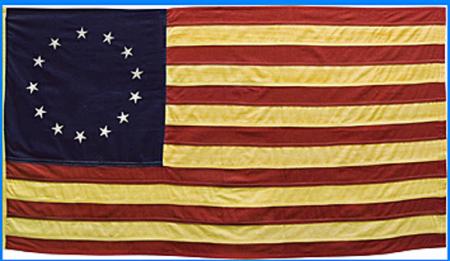
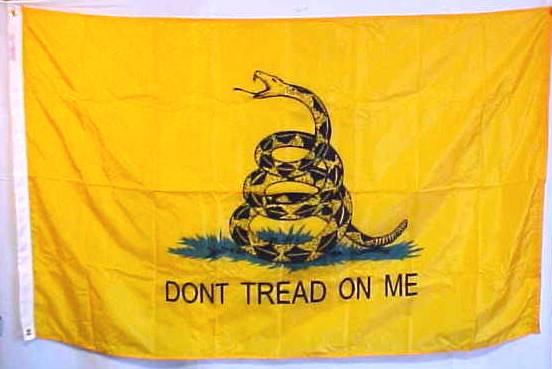
Then there was the awkward moment that inspired this blog post. Rather than give an account of what took place, an account that might not fairly capture what I saw, I want to laud my students for trying to create a tradition at our stadium that links an early symbol of our nation with the school mascot (the Patriot). Can students use a historical flag of our nation as a symbol at a game? Probably. But there is protocol they'll have to observe so as to not offend or violate the flag code. So, I think have an opportunity to help the student leaders figure out the right symbol to use.
![]() | ||||||
Is this an official U.S. flag? I'm not sure.
|
| Too cryptic and not from our region of the country. |
So there are lots of choices, but they each have their liabilities.
I hope they re-name the student section "Sons of Liberty" like they did a few years ago. Also, I think it would be awesome for them to figure out a way to don a student in colonial era garb who could carry one of these historical flags at the game in respectful but enthusiastic manner. They've got a chance to do something meaningful here.
I'm proud of my school's students, though, that they're seeking ways to reach into the past to find a national symbol that they can link to their school mascot. The teachable opportunity here comes in challenging them to figure out a system by which they make no mistake they're still honoring the country.
Thursday, September 3, 2015
14 Weeks of Stuff in 18 Weeks
![]() |
| One of about twenty pins I found in an old colleague's desk drawer. Seems appropriate. And it looked dapper on the purple outfit my daughter picked out. Scroll down for that photo. |
At first it seemed more pressing that I only had 13 weeks to do what I could otherwise do in 18. But now I'm coming to realize that in the fall, I have 18 weeks to do what I must otherwise do in 13. I have therefore come to the conclusion that I can . . .
relax.
It's not something one is used to in this line of work. But in some ways, I get the opportunity to leisurely start the year. I can take a week to get into a rhythm. I can shrug off a bad day or a lesson plan gone awry because I have time. And this time is with well-behaved, veteran students. Twelfth graders.
![]() |
| A seven-year-old photographer photographs the wardrobe she chose for her dad. It was very, very purple. |
Subscribe to:
Posts (Atom)